Gunter Beckenbauer
A Dog's Way HomeGunter Beckenbauer is the landowner whose plans to demolish a house bring him into conflict with Lucas Ray and the people trying to protect the feral cats living beneath it. He denies that cats remain on the site, contests the intervention that threatens to halt the demolition, and treats the protest against him as a personal and financial affront. Through his encounters with Lucas and Audrey, the dispute becomes not only a question of what is under the house, but of who has the authority to make that question count.
Identity and Introduction
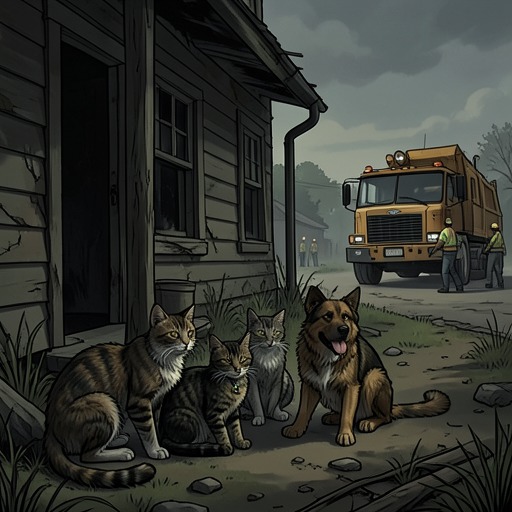
Gunter arrives at the site in a large, dark car after a man says he has spoken with him and expects him to handle the protester. From Bella’s close, animal-centered point of view, he is taller than Lucas Ray and broader around; his clothing and breath carry the smells of smoke, meat, and something sweet. That sensory introduction makes him a sharply physical presence before his position in the dispute is clear. He goes first to the other men, who look toward Bella as the only dog there, and then approaches Lucas to ask what is happening.
Lucas explains that cats are still living under the house and appeals to Gunter’s presumed concern that they might be hurt. Gunter rejects the premise: he says there are no cats and that all the cats have been removed. The disagreement is starkly framed. Lucas speaks of an ongoing presence beneath the building; Gunter answers as though the matter has already been settled.
The Cats and the Demolition Dispute
Gunter’s exchange with Lucas also reveals his irritation over the efforts being made to help the colony. He accuses Lucas of rolling back his fence, saying he has already sent men to repair it three times, and says it is obvious Lucas is feeding the cats. For Gunter, these are not separate acts: the damaged fence and the feeding are signs that Lucas is interfering with the situation on Gunter’s land. Lucas does not answer the accusation about the fence in that moment, and Bella, drowsy in his arms, registers the encounter through its physical details rather than its argument.
The conflict becomes explicitly administrative when Audrey says she is with animal rescue and has contacted the building commission. She reports that the demolition permit is being pulled because feral cats are present, and warns that proceeding with the demolition would be illegal. Gunter scoffs at the speed of the response, insisting that officials cannot act so quickly. Audrey explains that a board member who is also a county commissioner has called. The exchange places Gunter’s plans against an intervention that can interrupt them: his confidence that the demolition will proceed meets the prospect of a permit being withdrawn.
Money, Authority, and Conflict with Lucas
In a later confrontation, Gunter tells Lucas to stay off his land and threatens to have him arrested for trespassing if he catches him there. The warning makes the property boundary a direct instrument of the conflict. Lucas answers dryly, and the two men do not shake hands or otherwise touch as they part—an ordinary gesture of leave-taking conspicuously absent from their encounter.
Gunter also describes a financial offer that Lucas has rejected. He says Lucas could have had a thousand dollars, accuses him of trying to extort money, and claims he had been trying to help. Lucas counters that Gunter insulted him first by suggesting he compromise for a few pieces of silver, and rejects the implication that he would take the money. The scene does not resolve their disagreement about the offer; instead, it exposes their opposed accounts of it. Gunter presents himself as having made a good deal and Lucas as unreasonable, while Lucas treats the offer as an insult and refuses its terms.
Gunter then proposes another route around the obstacle: he says he could find an animal-control officer willing to sign a statement that there are no cats under the house, and that this would probably cost less than a thousand dollars. The suggestion links his financial grievance to the original dispute over evidence. Rather than accept Lucas’s claim that cats remain, Gunter imagines obtaining an official statement that would support the opposite conclusion.
The Protest and Its Aftermath
Gunter later complains to Terri about the protest, saying Lucas had a group of friends stage a phony demonstration on his property. He asks why Lucas is doing this to him and what he has done to either Lucas or Terri. Terri replies that Lucas is trying to save innocent animals. Gunter’s account makes the protest an injury to his property and a grievance against the family; Terri’s answer redirects attention to the animals at stake.
Gunter also says his website has received death threats and threatens to sue Lucas and Terri. The threat broadens the dispute beyond the demolition site, while his complaint presents him as the target of consequences arising from the conflict. The supplied encounters show him using several forms of leverage—property restrictions, money, the possibility of an animal-control statement, and threatened legal action—while the rescuers insist that cats remain beneath the house.
Narrative Role
Gunter’s certainty that the cats have been removed is set against Lucas’s firsthand observation and Audrey’s account of the permit response. The story does not make the argument abstract: it attaches each position to a house, a fence repaired three times, animals below ground, and a demolition that may be halted. Gunter is therefore the human opposition around which the immediate rescue effort turns. His disagreements with Lucas concern both the cats’ presence and the terms on which the land, the evidence, and the decision to proceed will be controlled.